
 Previous

Think tanks and civil society organisations (CSOs) are vital pillars for democracy, social development, and policy advocacy across Latin America. Ecuador, as in many other countries, CSOs face crucial challenges in sustaining their work amid a rapidly shifting funding landscape and increased political polarisation. This blog unpacks the operating environment for think tanks and CSOs in Ecuador¹ and the significant role played by international funding.
Download the On Think Tanks State of the Sector Report 2025
CSOs in Ecuador: Sector under financial pressure
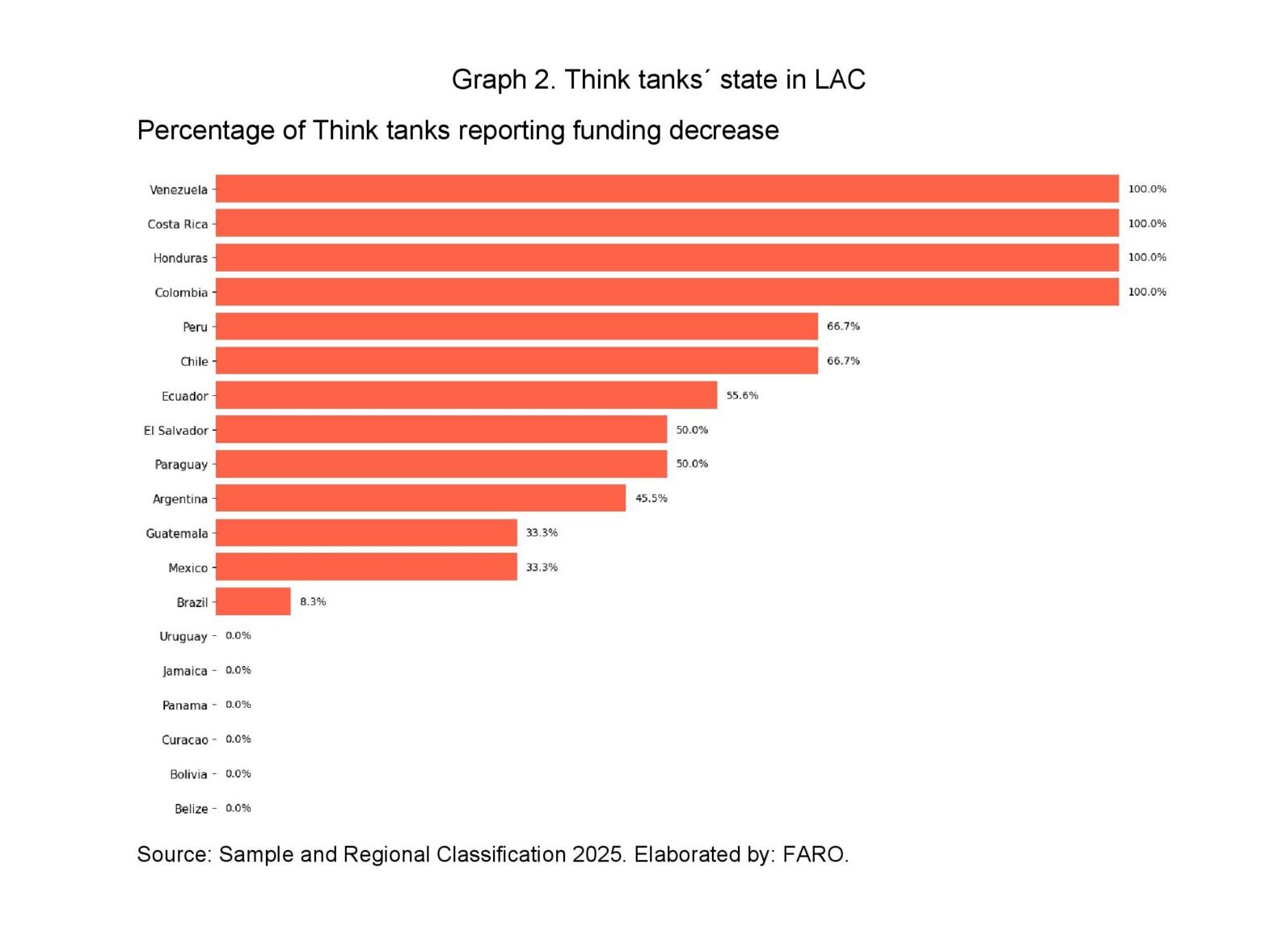
The 2025 State of the Sector survey reveals a challenging environment for think tanks in Ecuador, with over 55% reporting a decrease in funding over the last year. More than three-quarters identify fundraising as their most pressing challenge. Despite the majority relying on international donors, these sources have proven volatile. Only 22% of organisations saw funding increases, while 56% depend mainly or entirely on international support. Multiple factors contribute to this funding contraction:
- Shifting donor priorities: With USAID and similar agencies reviewing their global engagement and, in some cases, reducing allocations to Latin America, Ecuadorian think tanks are feeling the pinch.
- Increased competition: With fewer available funds, heightened competition has emerged among local organisations, prompting many to seek new strategies and partnerships.
- Political and economic instability, as well as national and global polarisation, have made international donors more cautious, focusing on risk mitigation and measurable short-term impact.
Graph 1. Top needs among Ecuadorian think tanks
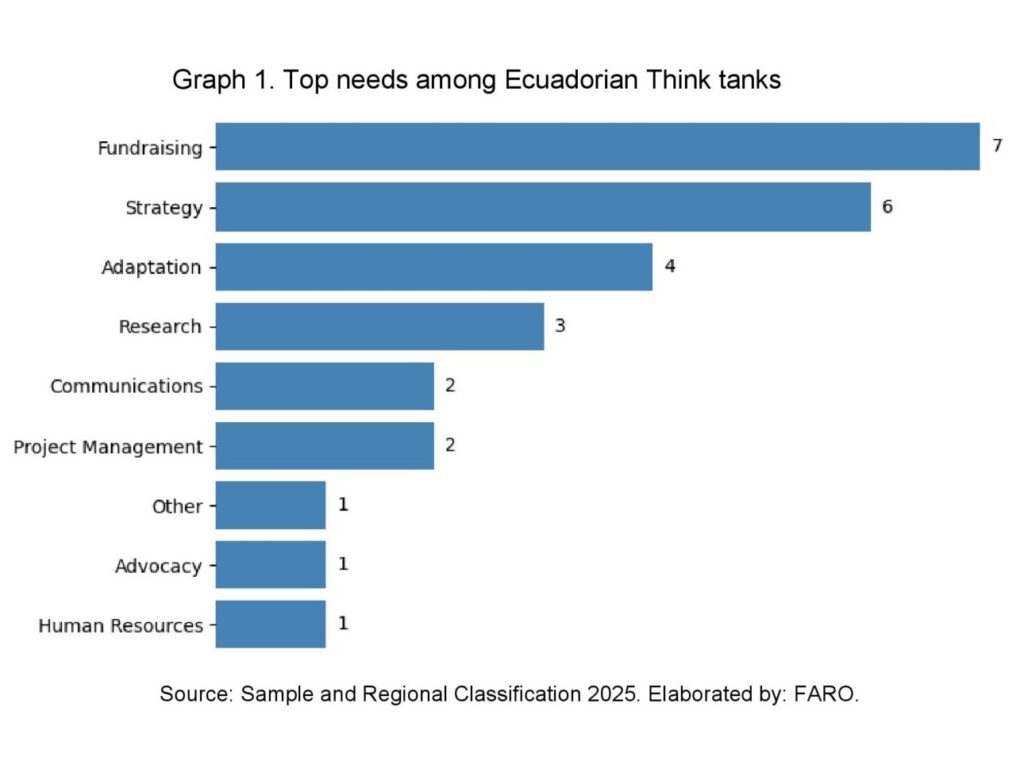
Source: Sample and Regional Classification 2025. Elaborated by: FARO.
The impact of changes in USAID support is heterogeneous in Ecuador. As some organisations report minimal influence, others identify it as a “high-importance” factor for their future viability. Nevertheless, every respondent said that the political situation in the last year affected them in an “unfavourable” way. The same was seen in expectation for the next year, except for three think tanks that expected a “neutral” effect.
When compared to the broader Latin American and Caribbean (LAC) region, Ecuador’s think tanks appear particularly dependent on international funding. While LAC think tanks have diversified their funding base over the past decade, Ecuador’s sector remains more exposed to external shocks. For example, around 78% of surveyed Ecuadorian think tanks list international sources as their primary or sole source of income, compared to a lower regional average.
Graph 2. Think tanks’ state in LAC
Percentage of think tanks reporting funding decrease
Share of think tanks with mostly/entirely international funding
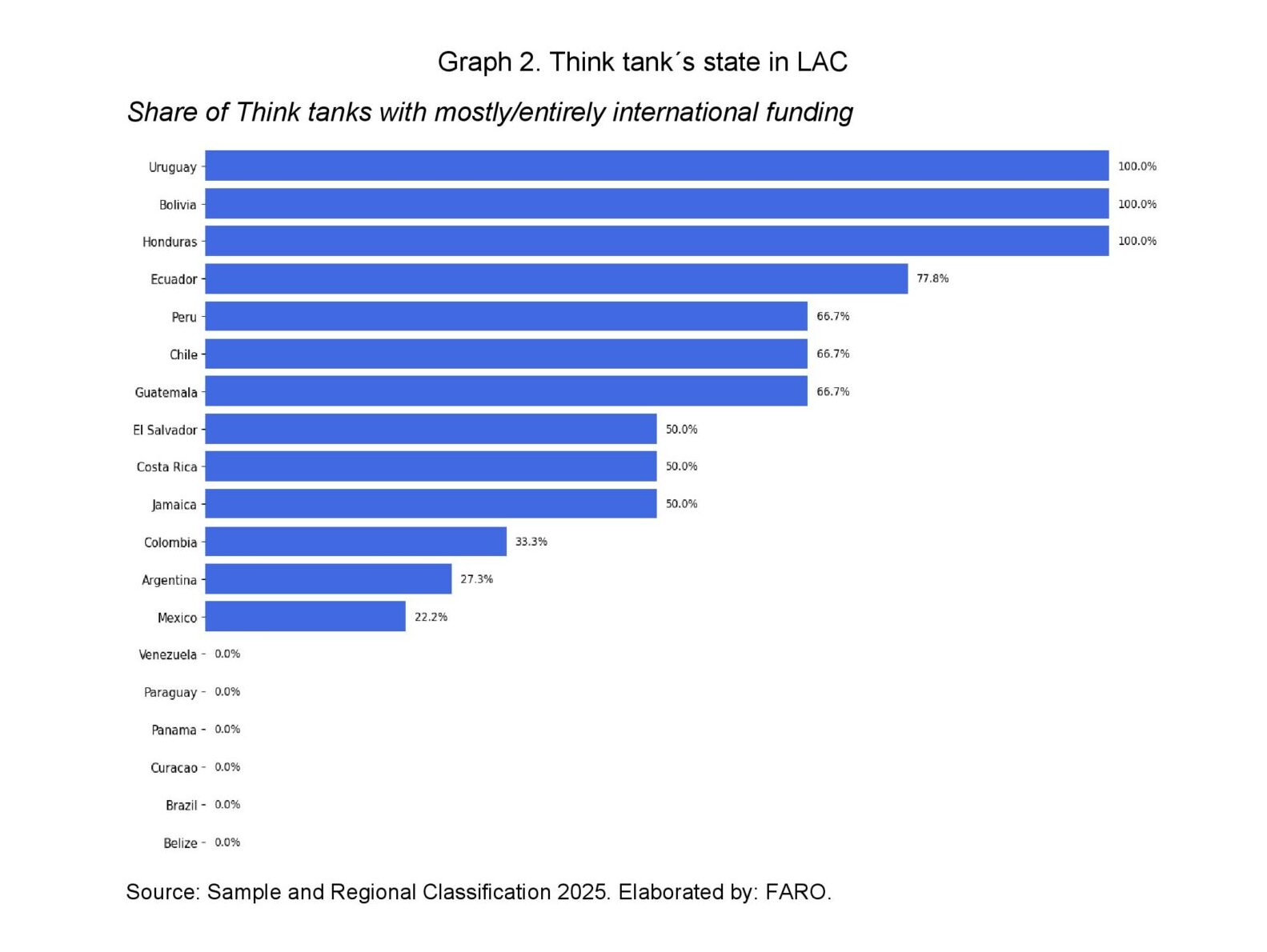
Source: Sample and Regional Classification 2025. Elaborated by: FARO.
Financial stress is not the only obstacle facing Ecuador’s civil society sector. The 2025 Sample and Regional Classification survey reveals a complex organisational landscape that presents challenges and opportunities for sustainable development.
More than half of Chief Social Officers (56%) operate with lean teams of fewer than 10 staff members, a constraint that inherently limits operational capacity yet simultaneously demonstrates the sector’s remarkable resilience and adaptability in resource-scarce environments. This structural limitation is counterbalanced by a significant demographic advantage: over 65% of think tanks report that more than half their workforce consists of individuals under 35 years old, signalling substantial potential for innovation and the cultivation of future leadership within the sector.
The governance picture presents a mixed reality, with 78% of organisations maintaining financial transparency standards—a positive indicator for donor confidence and accountability—while only approximately half have established proper board oversight mechanisms, suggesting gaps in institutional governance that could impact long-term sustainability.
On the other hand, around 78% of surveyed think tanks have already adopted artificial intelligence tools, positioning them at the forefront of technological integration that could significantly amplify their research capabilities in an increasingly digital landscape.
Political polarisation: A growing threat
In Ecuador, every surveyed organisation described the current political context as “unfavourable” for think tanks, with 44% indicating political polarisation has “significantly” hampered their work. Despite this, Ecuadorian think tanks continue to generate policy briefs (89%), host public events (78%), and produce media outputs (67%). Their high youth engagement and adaptive strategies, such as digital advocacy and regional partnerships, suggest that the sector’s resilience should not be underestimated.
The landscape for think tanks in Ecuador in 2025 is characterised by financial instability, heightened by declines in USAID and other development aid. The sector remains highly dependent on international donors, making it vulnerable to shifts in global priorities. On the side of operational challenges, political polarisation and small staff sizes are crucial. However, there are promising factors: strong youth participation, ongoing commitment to transparency, and continued policy influence. Addressing these challenges will require innovation, diversified funding, and strategic alliances—within Ecuador and across the region.
- The 2025 Sample and Regional Classification survey received 335 complete responses from over 100 countries, of which nine responses are from Ecuador. The survey´s data provide valuable insights to evaluate Ecuador´s think tank environment. Nevertheless, this sample is not representative of the overall population.
